Viet Tan members “abducted” or “entered illegally” into Vietnam?
 By An Điềm

Original article in Vietnamese ↗
Many precedents of abduction later labeled “illegal entry,” but there are also Viet Tan members who were arrested after returning to the country.
An Diem, Radio Free Asia, September 29, 2026
Two Vietnamese-origin political activists mysteriously disappeared on Cambodian soil for 10 days, then suddenly appeared at a Vietnamese police station, in detention.
The two are:
- Nguyen Duc Thuan (born 1974 in Lam Dong province, Norwegian citizen)
- Ho Pham Hiep Huy, also known as Tran Hiep (born 1975 in Saigon, Australian citizen)
From “caught red-handed entering illegally” to “terrorism” charges
According to information released on the evening of September 28 by the Ministry of Public Security, the two activists were reportedly “caught red-handed” at the My Quy Tay border gate in Tay Ninh province while “illegally entering Vietnam from the Cambodian border.”
Police also accuse Mr. Thuan and Mr. Huy of using “fake citizen identity cards.”
Another man, Thai Cong Truong Son (born 1980 in Dong Thap province), is also said to be connected to the case.
The Ministry of Public Security then issued decisions to open a criminal case, prosecute the defendants and order temporary detention for all three, on charges of “terrorism” (Clause 2, Article 299) and “forging seals and documents of agencies and organizations” (Clause 2, Article 341).
The police say the men themselves “confessed” to being members of Viet Tan and to using fake citizen identity cards to try to get into Vietnam in order to “carry out terrorist and sabotage activities.”
What does the Viet Tan party say?
On September 25, three days before the Ministry of Public Security announced the arrests of Viet Tan members, the political organization had proactively issued a notice that Mr. Thuan and Mr. Tran Hiep were “missing” in Cambodia.
In an interview with RFA, Mr. Hoang Tu Duy, a leader of the Viet Tan party, stated that the information released by the authorities is “completely untrue.”
“It is completely untrue, because throughout their schedule on Cambodian soil, the two had no intention whatsoever of returning to Vietnam.”
Of the three men, Viet Tan confirmed that Mr. Nguyen Duc Thuan and Mr. Tran Hiep are long-standing members of the organization.
Starting from Bangkok, Thailand, Mr. Thuan and Mr. Hiep reportedly had a four-day schedule in Cambodia, from September 15 to 19, to meet with several activists there.
While traveling to the Kaoh Andaet area, southwest of Phnom Penh, the two mysteriously disappeared.
“On the morning of September 18, everything was still normal, and they were still communicating with the outside. The last time we were able to contact the two was at 10 a.m. that day, during a journey in which they were traveling to the Kaoh Andaet area of Cambodia.
But a few hours later, and throughout September 18 until now, they have been completely out of contact,” according to Mr. Hoang Tu Duy.
The Viet Tan leader also said the two had planned to fly back to Bangkok on a flight landing in Thailand at 10:30 a.m. on September 19.
The Kaoh Andaet area that, according to Mr. Duy, Mr. Thuan and Mr. Tran Hiep were visiting, although near the Vietnamese border, is more than 200 km by road from the My Quy Tay border gate.
The only way they could have appeared in Vietnam as they have now is that they were “abducted by the police of the Communist Party government,” Mr. Duy asserted.
Another noteworthy point: the head of the Viet Tan party said he has “no specific information to share” about the third man, Thai Cong Truong Son.
Precedents of abduction later labeled “illegal entry”
There are earlier precedents of Vietnamese activists and dissidents who disappeared abroad and later appeared in the country confessing guilt.
More than 20 years ago, Thich Tri Luc, a monk of the Unified Buddhist Church of Vietnam, disappeared in a similar way on Cambodian soil.
After years of imprisonment and forced residence orders for demanding religious freedom, Thich Tri Luc left Vietnam for Cambodia to seek asylum in April 2002, and was subsequently granted refugee status by the United Nations.
However, not long afterward, the monk mysteriously disappeared in Phnom Penh in July 2002.
It was not until September 2003 that the Vietnamese Ministry of Foreign Affairs announced that it had arrested him more than a year earlier at a border guard station in Tay Ninh province. The authorities accused him of trying to flee abroad to contact organizations opposed to Vietnam.
During that entire year and more, his family had no idea whether he was alive or dead.
Thich Tri Luc was sentenced to 20 months in prison in a closed trial in Ho Chi Minh City in March 2004, and his sentence expired at the same time because of the detention he had already served.
Four days after his release, he wrote a handwritten letter to Human Rights Watch (HRW) and Amnesty International, recounting that in July 2002 he had been surrounded by a group of people, choked, handcuffed, struck on the face and head, and then put into a vehicle.
The vehicle took him through several locations, then to a building bearing Cambodian police insignia, where he was held overnight with his hands tightly cuffed.
At dawn the next day, he was taken to the Moc Bai border gate on the Vietnam-Cambodia border, and he said Vietnamese security forces were already waiting on the other side.
He said he saw the police of the two countries talking, shaking hands and laughing together before Vietnamese police took him to a detention camp in Ho Chi Minh City.
Based on these details, HRW and Amnesty accused the Cambodian side of cooperating with Vietnamese police to abduct Thich Tri Luc and forcibly return him to detention in Vietnam.
Also worth mentioning is the case of Mr. Duong Van Thai, who regularly leaked the authorities’ internal information on social media platforms.
Mr. Thai disappeared while seeking political asylum in Thailand in April 2023. The last image of him was captured by a security camera at a house near where he lived in Bangkok, showing him riding a motorbike past, followed by the sound of him shouting.
On April 16, state media reported that Mr. Thai had been arrested while “illegally infiltrating Vietnam” in Ha Tinh province.
The case drew the attention of human rights organizations and the international press, most of whom believed Mr. Thai had been abducted and taken to Vietnam.
A Hanoi court later tried Mr. Duong Van Thai for “conducting propaganda against the state” and sentenced him to 12 years in prison in October 2024.
Precedent of Viet Tan members arrested on returning to Vietnam
Mr. Chau Van Kham, an Australian citizen and Viet Tan member, is a well-known case of someone arrested upon returning to Vietnam.
According to Vietnamese police, Mr. Kham used an “identity card in the name of Chung Chinh Phi” to enter Vietnam overland across the Cambodian border in January 2019.
Mr. Kham was then arrested in Ho Chi Minh City on January 13, 2019, and charged with “terrorism aimed at opposing the people’s government.” In November 2019, the Ho Chi Minh City People’s Court sentenced him to 12 years in prison. However, he was released in July 2023 and returned to Australia.
Mr. Chau Van Kham’s case also drew the attention of human rights organizations and the international media, especially the Australian media.
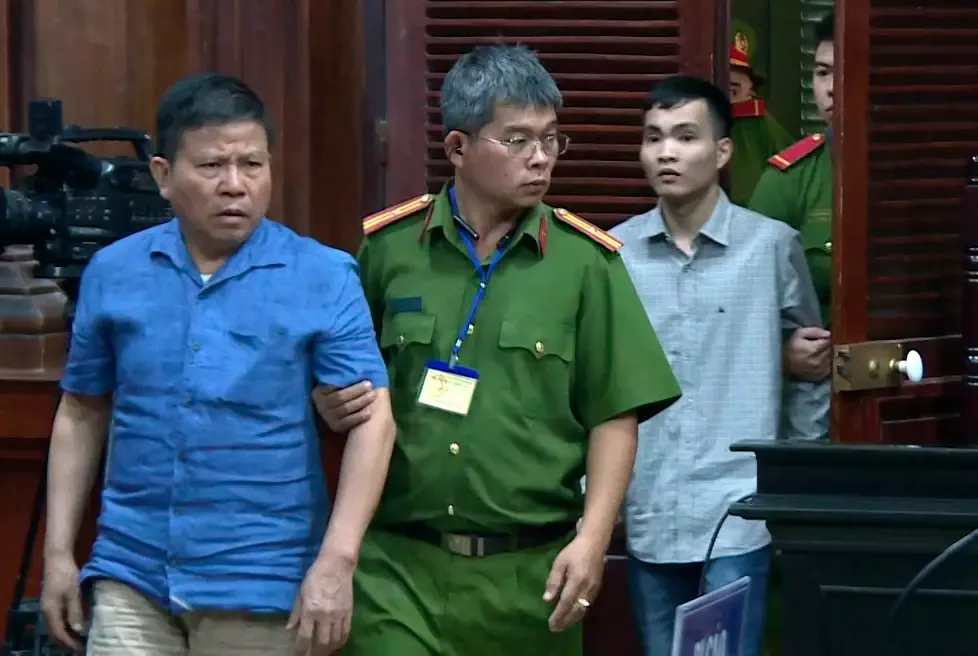
Photo caption: Mr. Chau Van Kham, accused of terrorism, appearing in court in Vietnam. (Vietnam News Agency / AFP)
Transnational repression rising under To Lam
According to human rights organizations, transnational repression targeting people who disagree with the government but live abroad has been increasing under To Lam.
This situation has grown more frequent since To Lam was still Minister of Public Security, through cross-border abduction cases such as that of Trinh Xuan Thanh in Germany, or two other activists in Thailand, Truong Huy Nhat and Duong Van Thai.
More recently, the authorities have repeatedly prosecuted and tried in absentia dissidents living abroad, including Messrs. Nguyen Dinh Thang, Le Trung Khoa and Nguyen Van Dai, and Ms. Dang Thi Hue.
As of the end of 2025, according to a Human Rights Watch report, Vietnam is holding more than 160 political prisoners, along with at least 40 others for criticizing the government.
The Viet Tan party is one of the organizations actively accusing the Vietnamese government of transnational repression. In June 2026, members of the organization lobbied at the European Parliament, urging it to condemn what they describe as transnational repression carried out by the Vietnamese authorities.