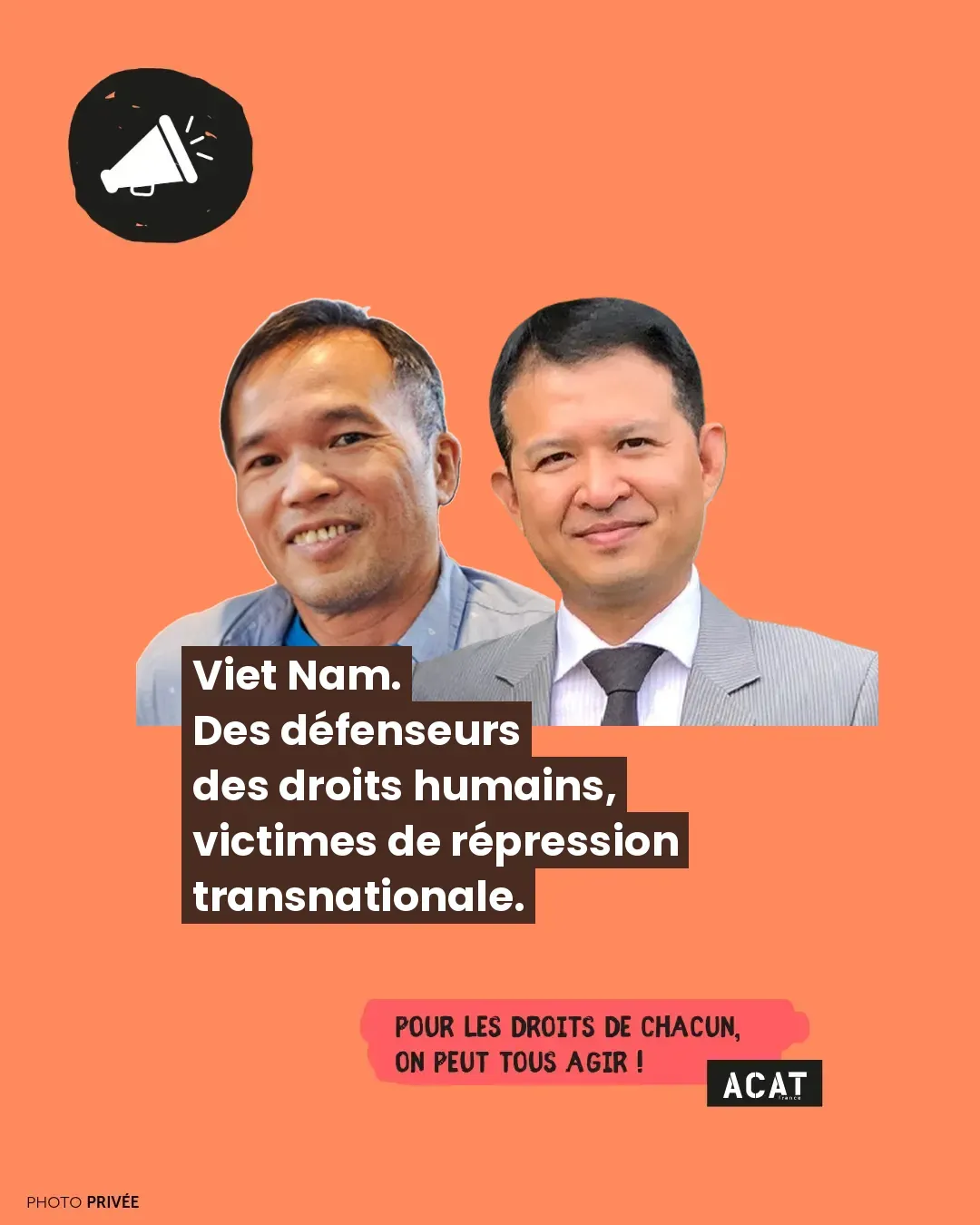
Vietnam. Three human rights defenders, victims of transnational repression
 By ACAT
The Facts
On 15 September 2026, Nguyen Duc Thuan and Tran Hiep, members of the pro-democracy organization Viet Tan, arrive in Phnom Penh to meet with several human rights defenders. They are joined by Thai Cong Truong Song, a Vietnamese national residing in Cambodia.
On 18 September, the three men disappear while heading to Kaoh Andaet, in southern Cambodia. For ten days, their families receive no news and no information is provided about their fate or place of detention.
On 28 September 2026, the Vietnamese Ministry of Public Security announces their arrest at the My Quy Tay border post, claiming they were attempting to enter Vietnamese territory illegally. Their relatives strongly contest this version and maintain that they were abducted in Cambodia before being forcibly transferred to Vietnam. Shortly before their disappearance, the three men were in contact with their families and had expressed no intention of traveling to Vietnam, where they risked arrest due to their human rights advocacy activities.
Vietnamese authorities now accuse them of acts classified as "terrorism" and are holding them in detention.
A forced disappearance followed by arbitrary detention
For ten days, the authorities refused to reveal the fate or place of detention of the three men, a situation that may constitute a forced disappearance under international law.
Following international pressure, Vietnamese authorities eventually authorized consular visits for Nguyen Duc Thuan and Tran Hiep, which took place on 15 and 16 October, nearly a month after their abduction. Thuan's condition is concerning as a diabetic: he is not receiving his usual insulin injections, despite alarming blood tests. Furthermore, the diet, based on white rice consumption, is unsuitable for his condition. Tran Hiep confirmed that he was abducted and forcibly transferred to Vietnam and remains deeply traumatized by this experience. He reportedly suffers from blood pressure problems, whereas his wife confirms he has no previous history of such issues, reinforcing concerns about his health condition.
Despite these consular visits, Vietnamese authorities continue to treat them as Vietnamese nationals, even though they fled Vietnam in the 1980s and 1990 due to political persecution, obtained refugee status, and subsequently acquired Norwegian and Australian nationality respectively.
Context
A systematic practice of transnational repression
The alleged abduction of Nguyen Duc Thuan, Tran Hiep and Thai Cong Truong Song is part of a campaign of transnational repression conducted by Vietnamese authorities against political opponents, journalists and human rights defenders living abroad. In July 2025, the UN Human Rights Committee expressed concern about allegations of forced disappearances and transnational repression practices attributed to Vietnam. These practices take the form of intimidation, abductions, forced transfers, and prosecutions based on terrorism allegations.
Several cases have been documented in recent years, including the abduction of Trinh Xuan Thanh in Germany in 2017, that of blogger Truong Duy Nhat in Thailand in 2019, that of UNHCR-recognized refugee Duong Van Thai in 2023, as well as the transfer to Vietnam of Y Quynh Bdap in 2025, also a UNHCR refugee. By now targeting a Norwegian citizen and an Australian citizen, Vietnamese authorities appear to be escalating their transnational repression strategy.
A partnership between the European Union and Vietnam
This case comes as Vietnamese President To Lam is expected in Brussels on 22 October 2026 to discuss strengthening relations between Vietnam and the European Union. However, the Framework Agreement on Partnership and Cooperation between the European Union and Vietnam, as well as the EU-Vietnam Free Trade Agreement, provide that respect for human rights constitutes an essential element of the bilateral relationship. The forced disappearances, arbitrary detentions, and transnational repression documented in Vietnam thus raise major questions about the compatibility of these practices with the country's international commitments.