Vietnam: Transnational repression persists with abduction of activists, critics targeted and new decrees that will increase digital rights violations
 By Civicus Monitor
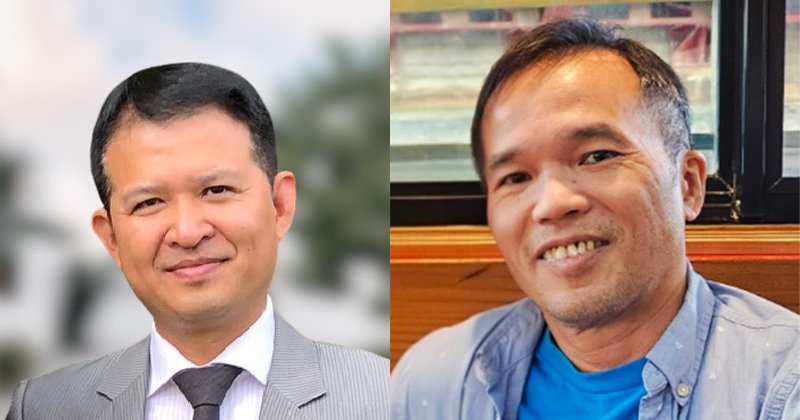
Nguyen Duc Thuan (L) and Tran Hiep (R) were abducted and detained by Vietnamese authorities (Photo Credit :Viet Tan)
The state of civic space in Vietnam is rated as ‘closed’. Among ongoing concerns documented are systematic attempts to silence human rights defenders, journalists and bloggers, including their jailing under national security laws, restrictions on their freedom of movement, and torture and ill-treatment in detention. There are also strict controls on the media, online censorship and controls on social media as well as ongoing restrictions on peaceful protests.
In recent months, the government abducted human rights activists from Cambodia as reports of transnational repression continued to be documented. Critics have been targeted and there are concerns over decrees operationalising the cybersecurity law. Publishing news affecting the country’s image may lead to large fines, Meta’s memorandum with Vietnam could increase online censorship and police threaten residents over Sun Group project protests.
Association
Government accused of abducting and detaining human rights activists
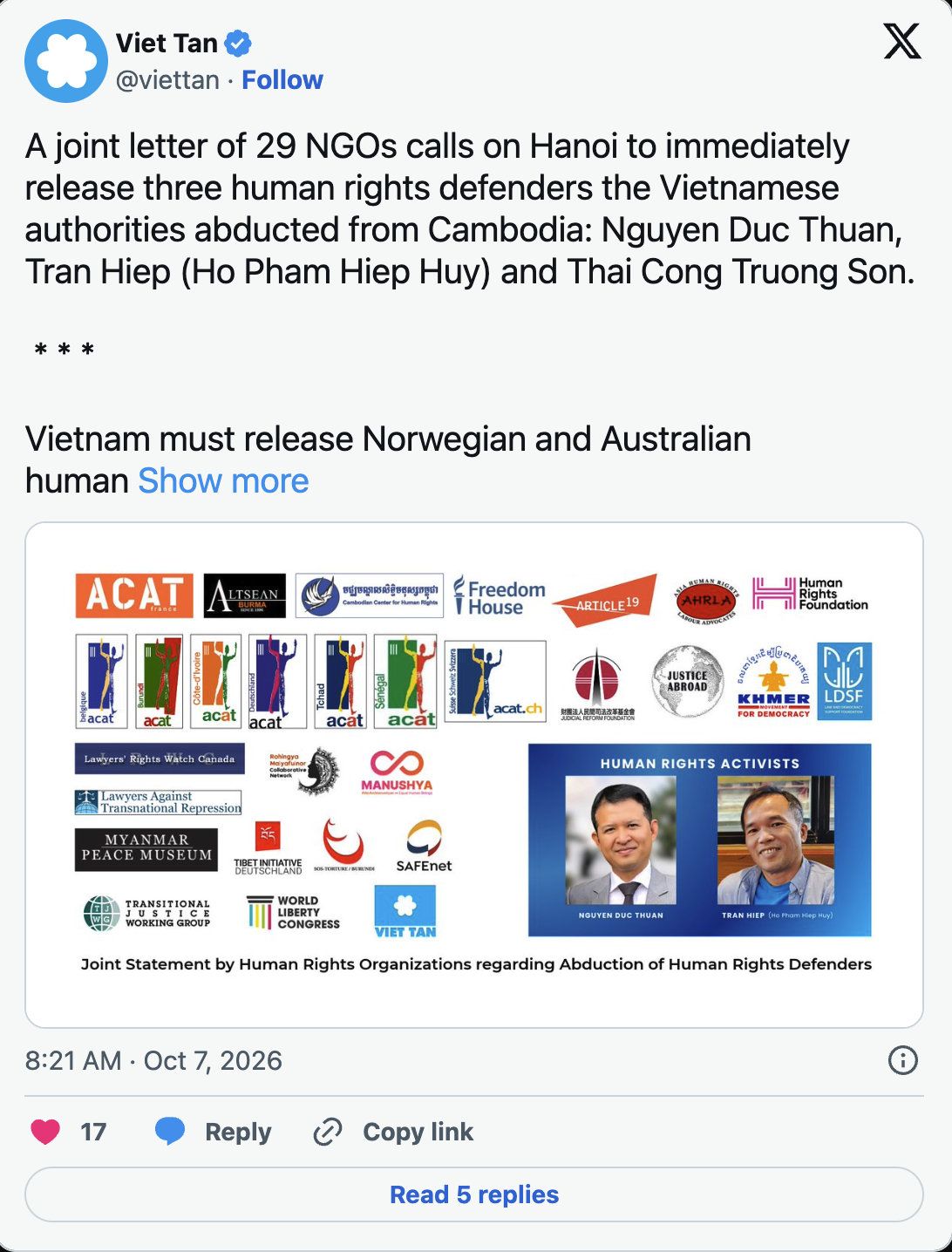
A joint letter of 29 NGOs calls on Hanoi to immediately release three human rights defenders the Vietnamese authorities abducted from Cambodia: Nguyen Duc Thuan, Tran Hiep (Ho Pham Hiep Huy) and Thai Cong Truong Son. * * * Vietnam must release Norwegian and Australian human rights defenders abducted in Cambodia 7 October 2026 We, the undersigned organizations, condemn in strongest possible terms the abduction of three human rights defenders by Vietnamese authorities in Cambodia and their subsequent arbitrary detention in Vietnam. The Vietnamese government must immediately and unconditionally release Nguyen Duc Thuan, a Norwegian citizen, Tran Hiep (Ho Pham Hiep Huy), an Australian citizen, and Thai Cong Truong Son, an ethnic Vietnamese living in Cambodia. Pending their release, Norwegian and Australian consular officials must be granted immediate access to Mr. Thuan and Mr. Hiep. Background Mr. Thuan and Mr. Hiep went missing on the morning of 18 September 2026 while traveling to the Kaoh Andaet area of Cambodia. For ten days, they were incommunicado. On 28 September, Vietnam’s Ministry of Public Security announced that the three men had been caught “illegally entering Vietnam” at the My Quy Tay Border Gate on 18 September. Subsequently, the three men are currently being investigated for “terrorism”. Their families and colleagues strongly reject this account. All available information points to the fact that the men were abducted on Cambodian soil and forcibly taken across the border. We are gravely concerned for the safety of Mr. Son as he is especially vulnerable without foreign consular protection. Mr. Thuan, 52, pharmacist, lives in Oslo and has long advocated for human rights in Vietnam with Norwegian and European parliamentarians. Mr. Hiep, 51, IT engineer, lives in Melbourne and has worked for years on social justice and anti-trafficking initiatives. Both are members of Viet Tan, a pro-democracy organization, and have been targeted solely for their peaceful advocacy for human rights and democracy in Vietnam. Mr. Thuan has diabetes and needs daily insulin. Any interruption to his medication puts his life at serious risk. Why this matters beyond Vietnam The enforced disappearance of two foreign citizens on Cambodian soil is a brazen act of transnational repression. It sends a message to every activist, journalist and individual in exile that no border nor foreign passport will keep them safe from Hanoi’s authoritarian reach. For ten days, the Vietnamese government held Mr. Thuan and Mr. Hiep in secret while their families pleaded for any word about their fate. This flouts Vietnam’s duty under the Vienna Convention on Consular Relations to notify Norway and Australia without delay and to give their consular officials access to its citizens. The terrorism charges are politically motivated and follow Hanoi’s long practice used against its critics. UN experts have repeatedly condemned Vietnam’s use of vague and over-broad terrorism laws, and its arbitrary designation of human rights groups operating in exile as “terrorist organizations,” as violating international human rights law. A growing and alarming pattern This abduction is the latest in the growing campaign of transnational repression by the Vietnamese authorities across Europe and Southeast Asia. In 2017, Vietnamese agents abducted former official Trinh Xuan Thanh in Berlin, prompting Germany to expel Vietnamese diplomats. Blogger Truong Duy Nhat was seized in Thailand in 2019 and later sentenced to 10 years in prison in Vietnam. Blogger and UNHCR-recognized refugee Duong Van Thai was abducted from Thailand in 2023 and sentenced to 12 years. In November 2025, Thailand handed UNHCR-recognized refugee Y Quynh Bdap over to Vietnam, where he is now imprisoned. Now Hanoi has crossed a new line by seizing Norwegian and Australian citizens. If the international community does not respond firmly, it will send a signal that Vietnam can continue to abduct foreign nationals without consequence. Our calls To the Government of Vietnam: Release Nguyen Duc Thuan, Tran Hiep and Thai Cong Truong Son immediately and unconditionally, and drop all charges against them. Grant Norwegian and Australian consular officials immediate and regular access, as required by the Vienna Convention on Consular Relations. Disclose where the three men are being held and grant them access to their families and lawyers of their choosing. Guarantee Mr. Thuan uninterrupted access to insulin and medical care. To the Governments of Norway and Australia: Demand immediate and regular consular access to Nguyen Duc Thuan and Tran Hiep, and keep the families informed of any developments, including refusals or delays. Raise the case with the Vietnamese government at the highest political level, and publicly call for the immediate release of your citizens. Engage like-minded governments and urge them to raise the case with the Vietnamese government and hold it accountable for transnational repression. We stand in solidarity with the families of Nguyen Duc Thuan, Tran Hiep and Thai Cong Truong Son. We will keep raising this case until all three men are free. Signed: ACAT Belgium (Action by Christians for the Abolition of Torture) ACAT Burundi ACAT Côte d’Ivoire ACAT France ACAT Germany ACAT Sénégal ACAT Switzerland ACAT Tchad Alternative ASEAN Network on Burma (ALTSEAN) Article 19 Asia Human Rights and Labour Advocates (AHRLA) Cambodian Center for Human Rights (CCHR) Freedom House Human Rights Foundation (HRF) Judicial Reform Foundation Justice Abroad Khmer Movement for Democracy (KMD) Law and Democracy Support Foundation (LDSF) Lawyers’ Rights Watch Canada Lawyers Against Transnational Repression Manushya Foundation Myanmar Peace Museum Rohingya Maìyafuìnor Collaborative Network SOS Torture Burundi Southeast Asia Freedom of Expression Network (SAFEnet) Tibet Initiative Deutschland e.V. Transitional Justice Working Group (TJWG) Viet Tan World Liberty Congress (WLC)— Viet Tan (@viettan) October 7, 2026
In September 2026, Vietnamese authorities detained three activists, including a Norwegian and an Australian linked to Viet Tan – an overseas political organisation that advocates for democratic change in Vietnam.
One of those detained is Tran Hiep, a 50-year-old Vietnamese Australian democracy campaigner. He was due to return to Bangkok, Thailand, to reunite with his wife after a short trip to Phnom Penh, Cambodia, to meet with human rights defenders.
Hiep, a freelance IT professional who founded the Australian Alliance to Combat Human Trafficking, was travelling with another human rights activist, Nguyen Duc Thuan, who is also Vietnamese and holds a Norwegian passport.
The pair travelled to Cambodia to meet with dissident Vietnamese activists for training. According to a Vietnamese government statement, they were arrested entering Vietnam from the Cambodian border along with a third person, Thai Cong Truong Son, an ethnic Vietnamese living in Cambodia.
The three men have been charged with “terrorism” under article 299 of the penal code for their association with Viet Tan, and with forgery of seals and documents under article 341.
In a joint statement, human rights groups say they were abducted in Cambodia. Thuan and Hiep went missing on the morning of 18th September 2026 while traveling to the Kaoh Andaet area of Cambodia. For ten days, they were incommunicado. On 28th September, Vietnam’s Ministry of Public Security announced that the three men had been caught “illegally entering Vietnam” at the My Quy Tay Border Gate on 18th September. Subsequently, the three men were investigated for “terrorism”.
They also said that “enforced disappearance of two foreign citizens on Cambodian soil is a brazen act of transnational repression” and “the terrorism charges are politically motivated and follow Hanoi’s long practice used against its critics.”
New report documents expanding transnational repression
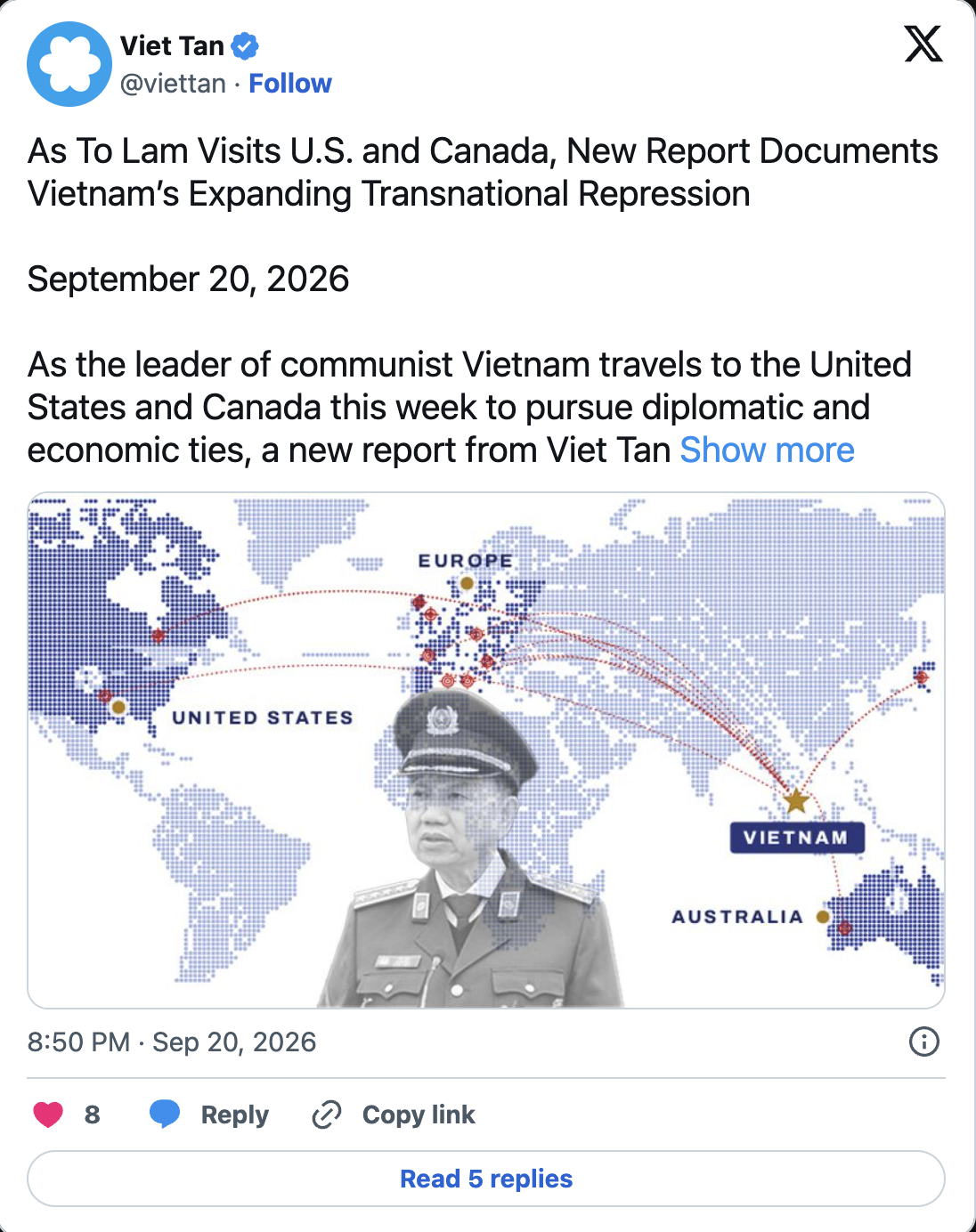
As To Lam Visits U.S. and Canada, New Report Documents Vietnam’s Expanding Transnational Repression September 20, 2026 As the leader of communist Vietnam travels to the United States and Canada this week to pursue diplomatic and economic ties, a new report from Viet Tan documents 20 cases in which Vietnamese authorities have pursued critics and human rights defenders beyond Vietnam’s borders. The report includes profiles of an ethnic Montagnard religious leader with American citizenship and a journalist with asylum in Canada. In 2018, US officials helped facilitate the resettlement of Pastor A Ga, an indigenous community leader and Christian oppressed in Vietnam. A year later, the White House invited Pastor A Ga to speak as a survivor of religious persecution, indicating the importance of his advocacy work for U.S. foreign policy. Despite gaining US citizenship and having his case reach the highest attention of the U.S. government, Vietnamese authorities have continued to issue arrest warrants with threats of extradition, an affront to U.S. commitment to religious freedom. On 22 September 2026, Pastor A Ga is scheduled to be trialed in absentia in Vietnam — on the same day To Lam is expected to speak at the United Nations General Assembly in New York. In Canada, Doan Bao Chau is a journalist with contributions to international media outlets such as AP, AFP, and Reuters. The Canadian government helped Doan Bao Chau resettle after fleeing to Thailand. After he fled Vietnam, the Hanoi People’s Court convicted Doan Bao Chau in absentia and sentenced him to seven years in prison due to social media reporting critical of the government. The efforts of the U.S., Canada, and other democratic countries to protect and support Vietnamese human rights defenders are tested under To Lam who is state president and General Secretary of the Vietnamese Communist Party. Viet Tan’s reporting finds that when the Vietnamese government imposes criminal penalties or intimidation on individuals living under the protection and jurisdiction of another state, it undermines the sovereignty of the very countries where those individuals reside. U.S. proposed legislation on transnational repression and Canada’s recently established commissioner on foreign influence are important efforts to challenge the reach of regimes like To Lam’s attempting to silence its critics. Governments should continue to scrutinize politically motivated extradition and law-enforcement requests, protect individuals facing transnational repression, and make respect for the rule of law an integral part of the bilateral relationship. #ToLam #TNR #transnationalrepression #humanrights #Vietnam— Viet Tan (@viettan) September 20, 2026
A new report from Viet Tan documents 20 cases in which Vietnamese authorities have pursued critics and human rights defenders beyond Vietnam’s borders.
The report highlights a wide range of methods including intimidation, surveillance, cyberattacks, administrative harassment, diplomatic pressure, and reprisals against family members. Through these methods the Vietnamese authorities seek to silence critical voices, deter political activism in exile, and maintain a climate of fear within overseas Vietnamese communities.
The report called on governments to scrutinise politically motivated extradition and law-enforcement requests, protect individuals facing transnational repression, and make respect for the rule of law an integral part of the bilateral relationship.
Expression
Local resident arrested for criticising the Gia Bình Airport Project
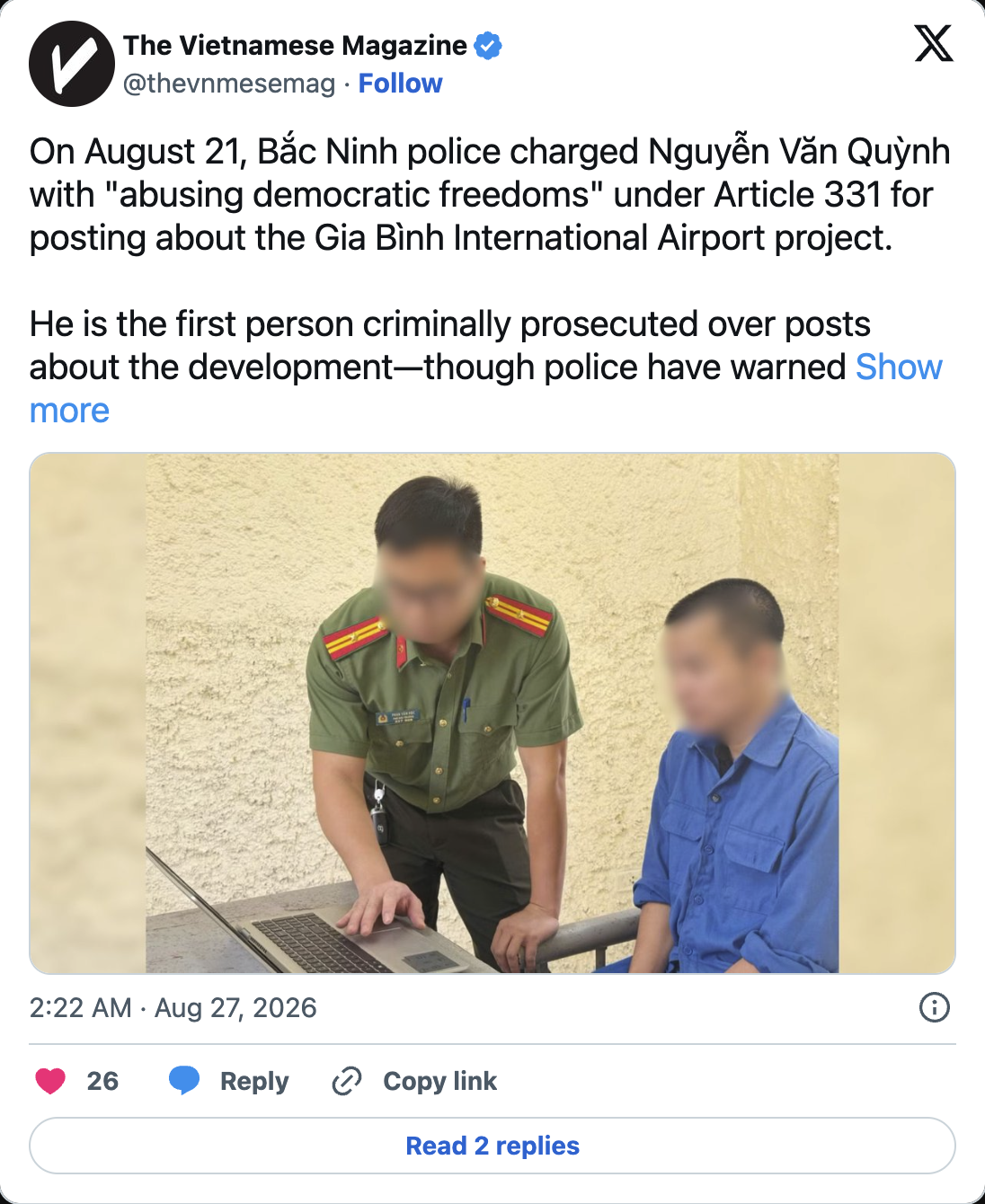
On August 21, Bắc Ninh police charged Nguyễn Văn Quỳnh with "abusing democratic freedoms" under Article 331 for posting about the Gia Bình International Airport project. He is the first person criminally prosecuted over posts about the development—though police have warned and fined dozens of others. Notably, authorities never disclosed what he posted or explained why it was false. The full news: https://t.co/GrFpiWl3U2— The Vietnamese Magazine (@thevnmesemag) August 27, 2026
On 21st August 2026, police charged Nguyen Van Quynh, a resident of Tam Da commune in Bac Ninh province, with “abusing democratic freedoms” under Article 331 of the Penal Code.
According to The Vietnamese, authorities alleged he shared “false information” regarding the Gia Bình International Airport project. Police said he published multiple pieces that damaged the reputation of government agencies and organisations, affected security and public order, and delayed the Gia Bình International Airport project.
While police had previously issued administrative penalties and warnings to several people who posted information about the Ministry of Public Security (MPS) project, he is the first person to be criminally prosecuted over posts concerning the development.
The Gia Bình International Airport Project is overseen by the MPS. Nearly 1,960 hectares of land will be acquired, affecting approximately 7,100 households and 118 organisations. Approximately 5,800 households are expected to be resettled.
Facebook account owner taken into custody
On 21st September 2026, the Can Tho City Police announced that it had initiated a criminal case, indicted and temporarily detained Nguyen Thi Chau to investigate her actions of "abusing democratic freedoms " under Article 331 of the Criminal Code.
Article 331 of the Criminal Code has been used repeatedly in recent years to prosecute bloggers, lawyers, journalists, and activists for online commentary, with human rights groups documenting hundreds of convictions under Article 331 since 2018.
According to the police, the account had “posted several articles containing information allegedly untrue, affecting the reputation, honour, and legitimate rights and interests of relevant agencies, organisations, and individuals.”
Officials take down protest banners
In August 2026, The Vietnamese reported that neighbourhood officials in Hanoi’s Linh Nam Ward removed banners opposing the Red River Scenic Boulevard Project while putting up national flags ahead of Vietnam’s National Day, on 2nd September 2026. A municipal government report later portrayed the removals as a voluntary act by residents celebrating the holiday.
On 29th August, residents of historic Thuy Linh Village reported that someone had taken down banners calling on authorities to preserve their community. According to the resident-run Facebook page, the neighbourhood group leader mobilised several people to remove banners at Alley 95/8/7 in Residential Group 23 without the affected households’ consent.
The removal prompted strong objections and residents went to the neighbourhood group leader’s home, demanded an explanation, and asked to see the written order authorising the action.
Since May 2026, banners demanding the preservation of existing communities and opposing complete clearance have appeared across areas affected by the Red River Scenic Boulevard Project. Residents have used them as a peaceful means of asking authorities to reconsider mass relocation.
The Red River Scenic Boulevard Project is a proposed $28 billion urban redevelopment project spanning 16 communes and wards. Covering about 11,418 hectares, it is expected to affect roughly 200,000 residents.
Concern over decrees operationalising the cybersecurity law
On 19th August 2026, Vietnam issued seven decrees (327–333) operationalising parts of its new Cybersecurity Law, in force since 1st July 2026. Concerns have been raised that these laws could further undermine digital rights and freedom of expression.
HRF expressed concern over Decree 330, which grants sweeping powers to commune-level officials to impose fines of up to VND 100 million (approximately USD 3,825) for certain cybersecurity violations. The decree also authorises commune-level police to suspend licences or operations and order the removal, deletion, or correction of information.
According to HRF, the decree highlights the regime’s continued efforts to restrict online expression and suppress criticism.
There are also concerns that Decree 328 will establish a process for authorities to label information as false. The new decree empowers authorities to publicly disclose individuals accused of spreading “false information” at their homes and workplaces - without providing them ample opportunity to defend themselves. Under Article 8, the new regulation allows authorities to publicly name individuals accused of posting false information well before enforcement proceedings are complete under Article 8.
Decree 333 allows accounts to be temporarily blocked after three violations in 30 days, compared with five previously. It also details a six-hour deadline for providers to remove unlawful content in urgent cases involving national security; compared with 24 hours previously.
Publishing news affecting country’s image may lead to large fines
On 29th September 2026, The Vietnamese reported that publishing news that negatively impacts Vietnam’s image or foreign relations can now result in administrative fines of up to 400 million dong (USD 15,400) under a newly implemented government Decree 367/2026. The decree was signed and took effect on 26th September 2026.
Under Article 14, Clause 8 of the new decree, organisations face fines ranging from 300 million to 400 million dong (USD 11,587 to 15,400) for “publishing or broadcasting information that negatively affects Vietnam’s standing, reputation, or image; harms foreign relations or international cooperation between the Socialist Republic of Vietnam and other countries or partners.”
Individuals face fines of 150 million dong (USD 5,800) to 200 million dong (USD 7,724) for the same offences.
These penalties also apply to publishing or broadcasting information deemed inconsistent with the interests of the country and its people; distorted or fabricated information that causes public alarm.
However, the decree does not define what constitutes a negative effect on Vietnam’s standing, reputation, or image, nor does it specify the criteria for determining whether a news article “harms” foreign relations or international cooperation.
Meta’s memorandum with Vietnam could increase online censorship
On 23rd September 20265, the Deputy Minister of Culture, Sports, and Tourism, Hoang Dao Cuong, and a Meta representative signed a memorandum of understanding to “strengthen cooperation and harness digital technology in areas under the ministry’s oversight.”
The memorandum specifically emphasises cooperation to make content “healthier” across Meta’s social media platforms - Facebook, Threads and Instagram - and coordinate action against “content that violates the law.”
There are concerns that this could increase online censorship. Currently, Facebook and Threads are Vietnam’s two most popular social media platforms, but both face heavy censorship.
In 2025, the Ministry of Information and Communications proudly announced that nearly 11,000 Facebook posts had been removed in the third quarter of 2025, along with 705 YouTube videos and 798 TikTok clips, including content deemed “anti-Party, anti-State or harmful to national security.”
In June 2026, Meta agreed for the first time to remove Threads posts at Vietnam’s request.
Thread blocks posts opposing the Ba Vi safari park project
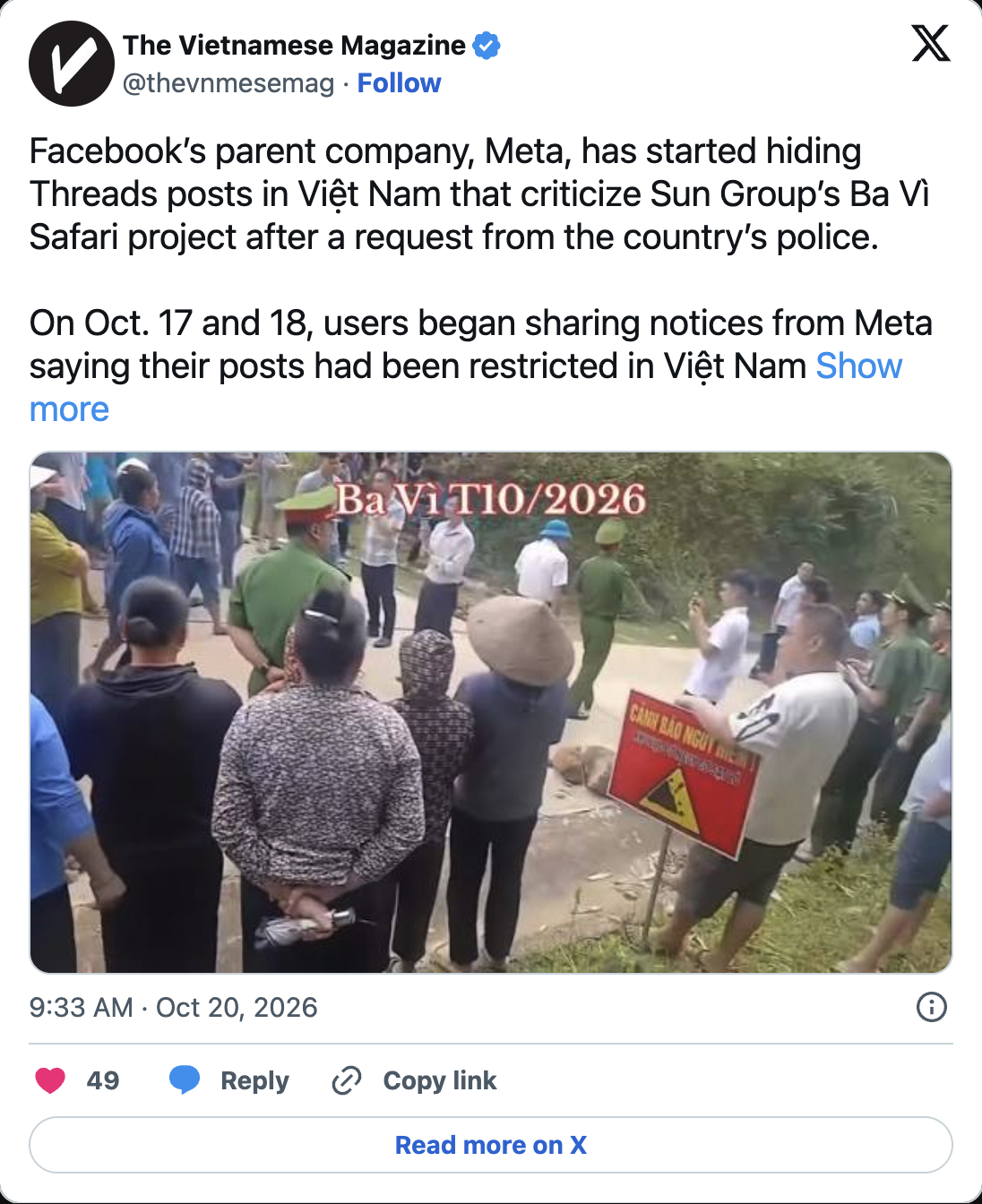
Facebook’s parent company, Meta, has started hiding Threads posts in Việt Nam that criticize Sun Group’s Ba Vì Safari project after a request from the country’s police. On Oct. 17 and 18, users began sharing notices from Meta saying their posts had been restricted in Việt Nam because of a request from the Ministry of Public Security. Most of the blocked posts accused authorities of keeping residents in the dark about land seizures, compensation, and the project’s boundaries. One compared the dispute to the deadly 2020 Đồng Tâm land conflict. Users have begun spelling “Ba Vì” backward to get past the filters. The posts remain visible outside the country and to people using VPNs. Neither Meta nor the police have said how many posts were blocked or which law was cited. The case shows how quickly criticism of a major development can disappear from Vietnamese social media. Read more: https://t.co/YJKAbH9uGG— The Vietnamese Magazine (@thevnmesemag) October 20, 2026
On 17-18th October 2026, a growing number of Threads users reported that their posts opposing the Sun Group’s Ba Vì Safari Park project were restricted or blocked.
According to The Vietnamese, residents of Ba Vì - in the mountain range just outside Hanoi - were not told about the boundaries, compensation, or zoning and only found out about it after the groundbreaking ceremony spread on social media.
Residents have hung red banners covered in slogans criticising the park, while others have questioned on social media what they would do once they’re moved off their land. Nearly 4,000 people could be affected, according to an initial assessment from officials in the capital.
Peaceful Assembly
Police threaten residents over Sun Group project protests
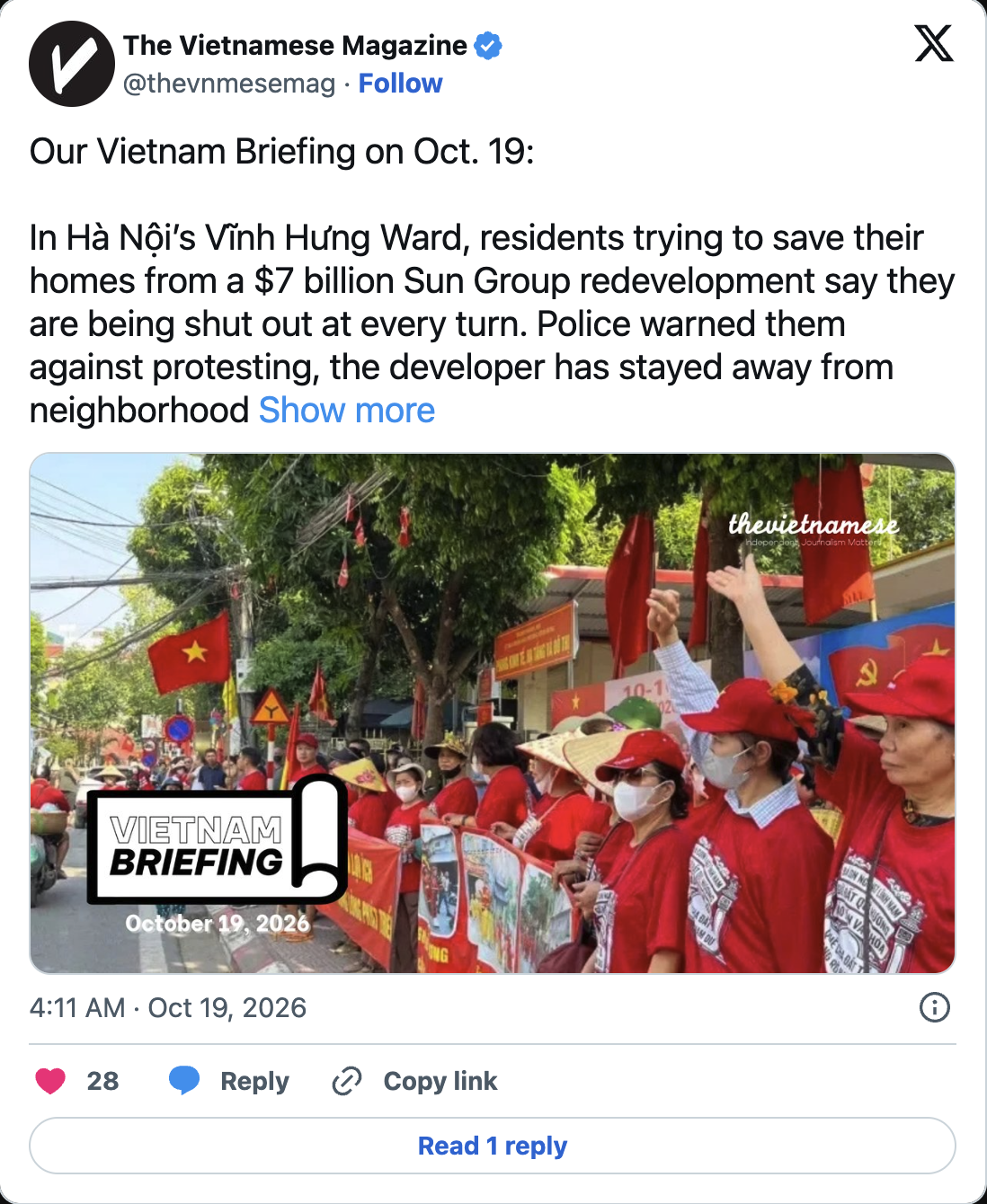
Our Vietnam Briefing on Oct. 19: In Hà Nội’s Vĩnh Hưng Ward, residents trying to save their homes from a $7 billion Sun Group redevelopment say they are being shut out at every turn. Police warned them against protesting, the developer has stayed away from neighborhood meetings, and the city’s state broadcaster cut their objections from the evening news. Some residents of nearby Đầm Ấu, who were resettled here once before, now face being moved a second time. Beyond land disputes, this week’s briefing covers: --\> Europe’s push to secure Việt Nam’s rare earths and tungsten as it seeks to cut reliance on China. --\> New analyses warning that Việt Nam’s clean energy transition could deepen its dependence on Beijing. --\> Fading hopes for a meaningful South China Sea code of conduct. --\> Việt Nam’s new free trade deal with four European nations. ---\> Rising pressure to free jailed journalists Lê Anh Hùng and Phạm Chí Dũng, and Melbourne activist Trần Hiệp. Read more: https://t.co/KlP73qYInS— The Vietnamese Magazine (@thevnmesemag) October 19, 2026
Local authorities are using online threats and police summons against hundreds of residents who took to the streets to defend their homes from a multibillion-dollar megaproject.
From 8th to 10th October 2026, hundreds of Vinh Hung residents gathered outside government offices at every level and marched through the streets to oppose the Sun Group project. They condemned plans to take residents’ land for a shopping centre and demanded fair compensation if their land was taken. Police ordered residents to disperse when they gathered outside the Vinh Hung Ward People’s Committee.
On 10th October 2026, Vinh Hung ward police posted a propaganda message warning residents against “illegal gatherings and marches.”
The message appeared in the Facebook group which the police administer. In the Facebook post, police urged residents “not to listen to incitement or be drawn into illegal gatherings and marches, disturbing public order, or obstructing the work of agencies and organisations.” They stated that they would “proactively verify, gather evidence, and resolutely and strictly punish” violators under the law.
Furthermore, police directed residents to get their information from state agencies and not to post or share “false, unverified information” about the project. They stressed that all opinions and petitions should go to the relevant authorities, who would handle them under the law.
The post ended by asking residents to “stand with local authorities” to maintain security and order and to help the Sun Group project move forward. On that same day, a Facebook account posted a photo of a police summons calling a resident in to discuss the Sun Group project.
The Sun Group Project is a 447-hectare urban renovation and redevelopment project in Vĩnh Hưng ward, backed by a total investment of nearly 186 trillion dong (about USD 7.1 billion).